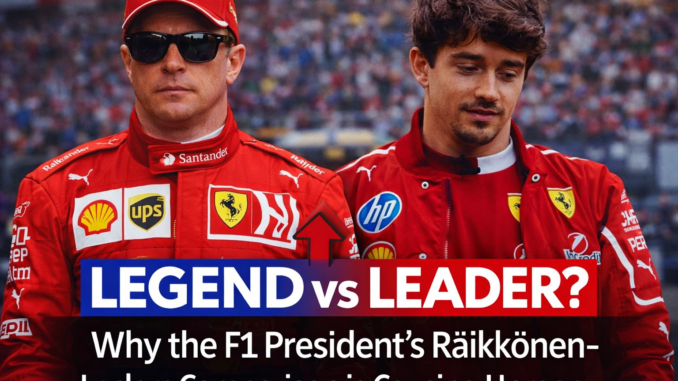
Legend vs Leader? Why the F1 President’s Räikkönen-Leclerc Comparison is Causing Uproar

In a moment that has ignited fierce debate across the Formula 1 world — from the paddock to fan forums — the sport’s leadership finds itself at the centre of an unexpected controversy. What began as an attempt to inject perspective into a challenging season has instead triggered a broader discussion about leadership, legacy, and respect in one of the world’s most intensely scrutinised sports.
This storm started not on the track, but in a media room, when the President of the Fédération Internationale de l’Automobile (FIA), Mohammed Ben Sulayem, made remarks that many interpreted as a contentious comparison between Kimi Räikkönen’s celebrated legacy and the current generation represented by drivers like Charles Leclerc. While the exact wording of the comment varied across reports, the gist — that today’s drivers would benefit from emulating the stoic, measured approach of a past “legend” — unleashed a wave of reaction throughout the F1 community.
The Remark That Started It All
Although the president’s comment was intended to discuss attitude and decorum — contrasting what he characterised as a more reserved mindset of past champions like Räikkönen with the vocal, media-engaged style of modern racers such as Leclerc — the comparison struck a nerve. Fórmula 1 fans and insiders alike seized on the implied value judgment: that a driver’s worth could somehow be ranked not just by results, but by their public persona and perceived humility.
Ironically, these comments came against the backdrop of a tumultuous season for Ferrari, where team leaders have previously been at the centre of headlines for their public handling of their top drivers. Ferrari chairman John Elkann made waves months earlier by publicly telling drivers Charles Leclerc and Lewis Hamilton to “talk less and focus on driving” following a disastrous double retirement at the Brazil Grand Prix — remarks that prompted criticism, reflection and even an out-of-character retort from ex-world champion Jenson Button urging Elkann to “lead by example.”
While Elkann’s comments targeted Ferrari’s internal struggles, Ben Sulayem’s comparison between past and present drivers broadened the conversation beyond Ferrari to encompass the entire sport.
Why This Struck a Chord
Formula 1’s identity has always been entwined with its icons. Drivers like Ayrton Senna, Michael Schumacher, and Kimi Räikkönen are etched into the sport’s mythology not just for their results but for their personalities — whether ferocious, disciplined or enigmatic.
Today’s grid, however, is markedly different: drivers are more visible, more outspoken, and more engaged with fans through social media than ever before. They also juggle brand partnerships, global representation and constant media scrutiny in addition to on-track demands. For many supporters, this evolution is not a flaw — it’s the reality of modern sport.
“For all the reverence we have for past talents,” said one commentator, “the world has changed. Comparing drivers across generations on anything other than on-track performance is a fool’s errand.” This sentiment encapsulates much of the backlash: the belief that leadership should unite and uplift the sport’s participants, not remind them that they’re being judged by standards set in a different era.
Drivers and Fans Respond
Leclerc, Hamilton and other current stars have yet to publicly lean into the debate directly over the comparison, but social media has been ablaze. Fans have argued that even if Räikkönen’s stoicism is admirable, the world’s best drivers today are shaped by a different set of pressures — from constant media obligations to the commercial expectations of modern Formula 1.
In Ferrari’s case, the club’s history of dramatic leadership decisions — from driver pairings to public criticism — means that any comment from above is immediately scrutinised. Social commentators highlighted that Ferrari’s chairman pointing fingers at his own drivers, rather than addressing ongoing technical and strategic shortcomings, only fuelled the conversation about where true leadership lies.
Meanwhile, across fan forums and podcasts, the official FIA backlash has expanded into wider criticism of governance and tone. In the last couple of years, the FIA president’s stance on issues such as driver language and behaviour — including strict penalties for swearing — have already drawn complaints from the Grand Prix Drivers’ Association (GPDA), which urged the president to be mindful of his tone and to treat drivers like adults rather than children. This most recent comparison, interpreted by many as dismissive or nostalgic at the expense of current competitors, further amplified those concerns.
What This Means for F1’s Culture

At its core, the uproar reflects a broader tension within Formula 1 between tradition and transformation. The sport cherishes its legends, but it also needs to evolve. Drivers today are athletes, personalities, global ambassadors — and they want to be acknowledged as such.
Experts suggest that leadership could shift toward supporting its stars through mentorship, dialogue and collaboration, rather than through public comparisons that risk diminishing the achievements of modern talents.
“In an era where every word from leadership is measured and debated,” one F1 journalist observed, “the most powerful leadership is less about defining who is a ‘legend’ or ‘leader,’ and more about recognizing contribution wherever it comes from.”
As preparations continue for the upcoming season, and with Ferrari and the FIA both under intense scrutiny, the sport’s administrators might find that the most important legacy they can leave is one of unity and mutual respect — not comparison.
Leave a Reply