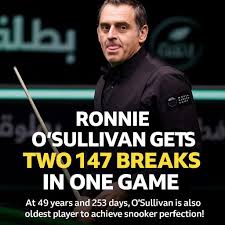
Fans Have Been Waiting for This: Ronnie O’Sullivan Explains Why He Can’t Be Compared to Any Other Snooker Player — And the Proof Is in the Records
For decades, the debate has raged across snooker halls, television studios, and online forums: Is Ronnie O’Sullivan truly in a league of his own? Now, after years of comparisons to legends like Stephen Hendry, Steve Davis, and John Higgins, the seven-time world champion has finally offered the clearest explanation yet as to why he believes comparison itself misses the point. And for many fans, the evidence now feels impossible to argue against.
Ronnie O’Sullivan has never been shy about speaking his mind, but in recent discussions surrounding his legacy, the “Rocket” has taken a more reflective tone. Rather than dismissing other greats, he has explained that his career exists on a different plane — not because of ego, but because of how fundamentally different his approach to the sport has been.
“I never tried to be the best in the traditional sense,” O’Sullivan has said in various interviews over the years. “I just wanted to play snooker in the most natural, expressive way possible.” That philosophy, many argue, is exactly what separates him from everyone else who has ever picked up a cue.
The statistics alone offer overwhelming proof. O’Sullivan holds the record for the most ranking titles in snooker history, the most Triple Crown titles, and the most century breaks ever compiled. His 15 maximum 147 breaks remain unmatched, and he continues to add to his tally well into his late 40s — an age when most professionals have long retired or faded into obscurity. No other player has sustained elite dominance across five different decades.
But numbers only tell part of the story. What truly separates O’Sullivan is how he achieved them. He revolutionized the sport with a faster, more aggressive style that defied the slow, methodical norms of traditional snooker. He proved that brilliance could coexist with instinct, creativity, and freedom. While others trained to perfect technique, O’Sullivan made the game look like an extension of thought itself.
Fans often point to his ambidexterity as a defining trait. Being able to play world-class shots with both hands eliminated the need for awkward rest shots and changed tactical possibilities forever. No other player has mastered this skill to such a degree under competitive pressure. It’s not just a gimmick—it’s a strategic advantage that has reshaped modern snooker.
Then there is longevity. Players like Hendry dominated an era but burned out early. O’Sullivan, on the other hand, has evolved. He adapted his game, improved his mental approach, and learned how to win without always playing his best. That evolution, experts say, is what truly separates legends from greats.
Beyond trophies and technique, O’Sullivan’s impact on the sport’s global appeal is unmatched. He brought a new audience to snooker—fans who might never have watched the game if not for his charisma, honesty, and occasional controversy. He made snooker mainstream in a way few players ever have, turning matches into must-watch events.
When asked why comparisons persist, O’Sullivan has often responded with humility mixed with realism: every great player is a product of their era. But the reason fans “can’t compare” him, as many now admit, is because no one else has combined longevity, artistry, dominance, and influence quite like he has.

In the end, the proof is not just in the records, but in the feeling he leaves behind. When Ronnie O’Sullivan steps away from the table, snooker doesn’t just lose a champion — it loses a once-in-a-lifetime phenomenon. And that, fans now agree, is why comparisons no longer make sense.
Leave a Reply