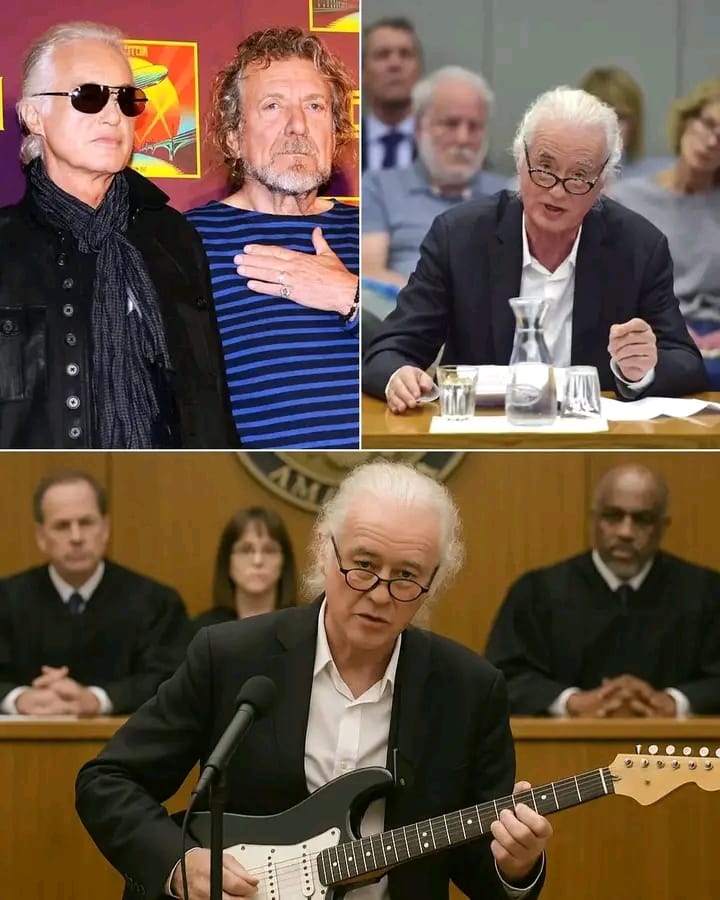
On This Day in 2016: Jimmy Page Played for His Legacy in Court—and Won
Nine years ago today, the hallowed chords of Led Zeppelin’s “Stairway to Heaven” didn’t echo through a stadium or a recording studio—they rang out in a courtroom.
It was June 27, 2016, when Jimmy Page, legendary guitarist and founding member of Led Zeppelin, stood before a federal jury—not to perform a concert, but to defend one of the most revered songs in rock history from accusations of plagiarism. The case centered on the song’s ethereal, now-iconic intro and whether it had been lifted from another piece of music: the 1968 instrumental “Taurus” by the California rock band Spirit.
The lawsuit, filed by Michael Skidmore, a trustee for the estate of Randy Wolfe (aka Randy California), Spirit’s late guitarist and composer, accused Page and Led Zeppelin frontman Robert Plant of stealing the “Stairway to Heaven” opening riff from Wolfe’s work. At stake: $79 million in damages, the reputation of two rock legends, and the legacy of what many consider the greatest rock song ever written.
What unfolded over the following days was one of the most extraordinary and dramatic courtroom showdowns in music history—a trial that pitted art against law, memory against melody, and legacy against liability.
The Lawsuit that Rocked the Rock World
“Stairway to Heaven” was first released in 1971 on Led Zeppelin’s untitled fourth album—commonly referred to as Led Zeppelin IV. The song, running over eight minutes long, is a slow-building, genre-defying epic that starts with a delicate fingerpicked acoustic guitar line before erupting into a thunderous, electric climax.
But it was that gentle, haunting intro that came under scrutiny.
Skidmore alleged that the opening of “Stairway to Heaven” was not original but rather taken directly from Spirit’s “Taurus.” Both tracks shared a descending chromatic scale, a melodic structure that seemed eerily similar, especially when isolated and compared side-by-side. Skidmore’s team argued that Led Zeppelin and Spirit had shared festival stages in the late 1960s, providing opportunity for Page and Plant to have heard and absorbed “Taurus” before composing “Stairway.”
To many fans, the claim was blasphemy. But in legal terms, it was a compelling enough argument to merit a full trial in a Los Angeles federal courtroom.
Jimmy Page Takes the Stand
Page, then 72 years old, took the witness stand with a solemn demeanor. Gone were the leather pants and stadium spotlights. In their place stood a man confronting decades of work under a microscope.
When questioned about the similarities between the two songs, Page admitted he had heard of Spirit and owned their albums—though he insisted he had never listened to “Taurus” until recently, when social media and fan forums began buzzing about the alleged connection.
“I had to listen to it once all this came to light,” Page testified. “Before that, I honestly didn’t recall it. We were all listening to so much music during that time—it’s entirely possible to own a record and never hear every track.”
The courtroom listened intently as both sides presented expert witnesses and musicologists. Some noted that while “Stairway” and “Taurus” share a descending chord progression, the structure itself dates back centuries and is commonly found in many compositions, from classical guitar études to folk ballads.
However, it was what happened next that would come to define the trial.
The Guitar That Saved “Stairway”
In a moment that now lives in rock-and-roll folklore, Jimmy Page was handed a guitar inside the courtroom. Jurors, lawyers, and the press watched as he gently tuned the strings, then began to play the “Stairway” intro—his fingers as fluid and precise as they were in 1971.
Page then played similar progressions from various other songs, demonstrating how the chord sequence in question was not only common but foundational to countless pieces of music. His calm, factual tone turned what could have been a performance into a demonstration—more lecture than concert, yet just as compelling.
“I wanted to show them the context,” Page later said in a post-trial interview. “Music doesn’t happen in a vacuum. It’s built on thousands of years of influence and variation.”
Observers noted that the moment was pivotal—if not legally, then certainly emotionally. A rock icon playing his most celebrated riff for a jury was not something the prosecution could easily counter.
Robert Plant’s Testimony: Memory and Emotion
Robert Plant also took the stand, adding a layer of poignancy to the trial. He described how “Stairway to Heaven” came together during long creative sessions at Headley Grange, a Victorian-era mansion turned recording retreat. Plant said he composed the lyrics on the spot, sitting by a fireplace, while Page strummed the now-famous chords nearby.
“I recall the feeling,” Plant told the jury. “It was spiritual. That’s why we called it ‘Stairway to Heaven.’ It came from a place of inspiration—not imitation.”
Plant also admitted he had no recollection of attending any concert where Spirit played, although some records suggested the bands had shared bills in 1968 and 1969.
The Verdict and the Aftershock
After a week of arguments, testimony, and courtroom guitar playing, the jury delivered a unanimous verdict: Led Zeppelin did not copy “Taurus.”
The court found that while there were similarities in structure, the musical elements in question were too generic to warrant copyright protection. The jury also noted the absence of concrete proof that Page or Plant had actually heard “Taurus” before writing “Stairway.”
Fans worldwide celebrated the outcome. Legal experts noted it could set a precedent in how courts treat music copyright cases, especially involving short phrases or common sequences.
Page and Plant released a joint statement afterward:
“We are grateful for the decision and for the opportunity to present the facts. ‘Stairway to Heaven’ has always been a labor of love, and we stand by its creation.”
Legacy Intact
Today, in 2025, the “Stairway to Heaven” trial is viewed not as a stain on Led Zeppelin’s reputation, but as an affirmation of their artistry. The courtroom saga reinforced how thin the line can be between inspiration and infringement—and how, even decades later, music can still stir controversy, emotion, and legal challenges.
The trial also sparked broader conversations in the music industry about the nature of originality in an age of infinite access and historical echoes. Many musicians came forward to share similar experiences of being accused of copying elements that are, in fact, part of the shared language of music.
A Moment That Echoes
Nine years later, the image of Jimmy Page calmly strumming his guitar before a jury is still burned into the collective memory of rock fans. It was a moment where the past was defended not with lawyers alone, but with artistry.
“Stairway to Heaven” still stands today, not only as a rock masterpiece but as a symbol of how legends are forged—not just in the fire of creativity, but in the crucible of scrutiny.
And on June 27, 2016, Jimmy Page didn’t just defend a song—he defended an era.
Leave a Reply